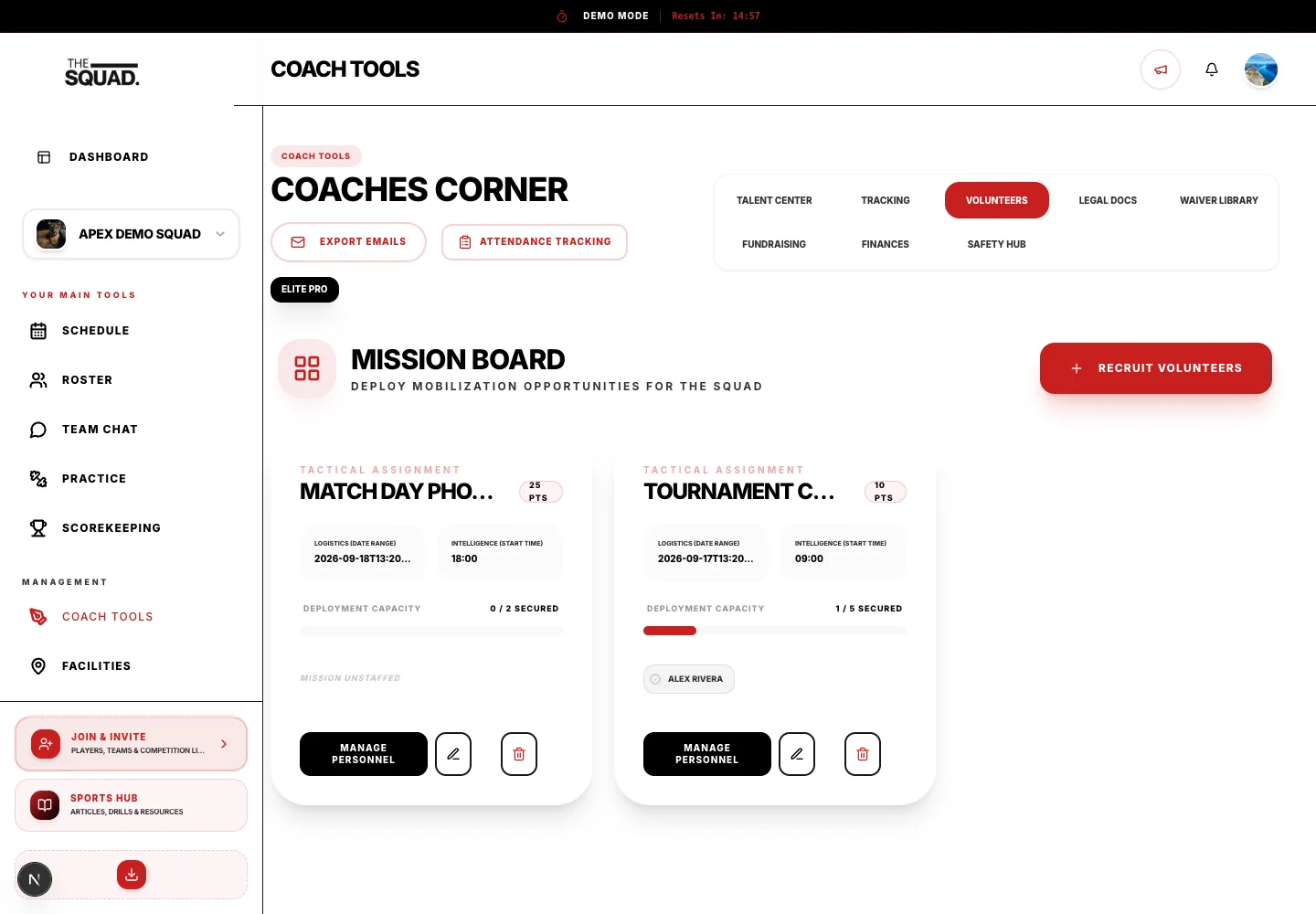
A volunteer program is a system of defined roles, recruitment, orientation, communication and support for people giving their time.
What does a volunteer need before the first shift?
Provide a role description, time and location, a briefing, a supervisor and a contact for problems before the shift starts.
Most youth sports organizations don't have a volunteer program. They have volunteer dependency — a constant scramble to fill last-minute roles through social media posts and personal favors, a rotating cast of inconsistently trained helpers, and a handful of burned-out parents doing most of the work.
This is not a volunteer problem. It's a systems problem. Volunteers want to help. Volunteers need to know what help is needed, how to provide it, and that their contribution is valued.
Building a real volunteer program transforms this dynamic. It creates reliability, builds community, and reduces the administrative burden on coaches and directors.
Step 1: Define Your Volunteer Roles
Start by listing every role volunteers fill in your program. Be specific. Vague roles ("general helper") produce vague outcomes.
Common volunteer role categories:
- Game day operations (setup, breakdown, score tables, timers)
- Team support (team parent, communication coordinator, carpool coordinator)
- Administrative (registration desk, payment processing, communications assistant)
- Field/facility operations (field prep, equipment management, facility monitoring)
- Events (tournament help, fundraiser coordination, end-of-season event)
For each role, create a one-page role description that includes:
- Time commitment (hours per week or per event)
- Specific responsibilities
- Skills or certifications required
- Who the volunteer reports to
- What training is provided
Step 2: Build a Recruitment System
Volunteer recruitment fails when it's reactive. Build proactive systems:
Season start recruitment:
- Send a volunteer interest form with your season registration (or separately in the first week)
- List all available roles and let families self-select based on interest and availability
- Make the form simple: name, contact, availability, role preferences
Role-specific asks:
- General appeals ("we need volunteers!") get worse response rates than specific asks ("we need 2 people to manage the score table from 9am–1pm on Saturdays")
- Specific asks reduce the effort of saying yes — the volunteer knows exactly what they're agreeing to
Social proof:
- Returning volunteers talking to new families is your most effective recruitment tool
- Highlight volunteers publicly (newsletter, social media, team app) to show it's valued
Step 3: Onboard Properly
The #1 reason volunteers don't return is that their first experience was confusing and unsupported. Fix this with structured onboarding.
Volunteer onboarding checklist:
- [ ] Written welcome and overview of the program's values and culture
- [ ] Role-specific training (even 20 minutes of shadowing beats "figure it out")
- [ ] Introduction to key staff and other volunteers
- [ ] Access to necessary resources (equipment locations, emergency contacts, communication channels)
- [ ] Clear escalation path — who do they contact when something goes wrong?
Step 4: Create a Communication System
Volunteers need to know what's happening and when without having to chase information.
Volunteer communication toolkit:
- Dedicated volunteer group chat or channel
- Weekly volunteer schedule (sent 5–7 days in advance)
- Day-before reminders for each scheduled volunteer
- Clear cancellation/change notification process
Step 5: Recognize and Retain
Volunteers who feel appreciated return. Volunteers who feel invisible don't.
Recognition doesn't require budget:
- Personal thank-you messages (specific, not generic)
- Public recognition in team communications
- Small tangible gestures: a coffee card at the end of the season, a thank-you note from the athletes
End-of-season volunteer appreciation:
- A brief dedicated event (or portion of the team's end-of-season event)
- Recognition of particularly impactful volunteers
- Feedback survey asking how to improve the volunteer experience
Ask returning volunteers what they want:
Some volunteers want more responsibility. Some want the same simple role every week. Understanding individual motivations lets you match volunteers to roles that sustain their engagement.
Building the Culture of a Volunteer Program
The best volunteer programs create a culture where volunteering is seen as part of being in the community — not a burden. This culture starts with leadership modeling appreciation, creating an environment where volunteers feel genuinely welcomed, and continuously improving the experience based on feedback.
Over time, your most effective recruitment tool becomes your existing volunteer community. When parents see their peers having a positive, valued experience, the recruitment problem largely solves itself.
Recruiting and Keeping Great Volunteers: A Complete Guide for Youth Sports Programs
The Volunteer Dependency Problem
Every youth sports organization runs on volunteer labor. But most organizations operate in a state of perpetual volunteer crisis — constantly scrambling to fill roles, burning out the same five people season after season, and losing experienced volunteers to burnout.
The solution is treating volunteer management like talent management. The same principles that help businesses attract and retain great employees apply to volunteer programs — adapted for an unpaid, values-driven context.
Understanding Why Volunteers Join (and Why They Leave)
Why People Volunteer for Youth Sports
- Their child participates — The most common motivation. As children age out, these volunteers often leave.
- Love of the sport — Former athletes who want to give back to the game.
- Community connection — People who value being part of their neighborhood community.
- Skills development — Adults who see volunteering as a way to develop leadership or event management skills.
- Social connection — Volunteers who enjoy the social environment of sports events.
Why Volunteers Leave
- Unclear expectations — They did not know what the role required and felt lost
- Poor communication — They were given last-minute information and felt disrespected
- Feeling unappreciated — Their time and effort went unacknowledged
- Role not matching skills — They were put in the wrong position
- Burnout — A few people carried too much; the load was not distributed
Recruitment Strategies That Work
1. Start With Your Existing Network
The lowest-friction recruitment happens through personal asks from people you already know. An email blast to 500 families yields 2 volunteers. A personal ask from one parent to three other parents yields 2–3 every time.
Make it personal: "We need help with the scoreboard at home games — I thought of you because you mentioned you love being at the games. It is only 90 minutes per game. Would you be willing?"
2. Define Roles Before You Recruit
Never recruit for vague needs ("we need volunteers"). Recruit for specific, bounded roles:
- Field Setup Coordinator (2 hours per home game, 8 AM arrival)
- Registration Table Lead (3 hours at season kick-off)
- Equipment Room Manager (30 minutes per practice to check gear in/out)
Write a one-paragraph role description for each position. When people know exactly what they are signing up for, commitment rates dramatically improve.
3. Expand Beyond the Parent Pool
- Local high school and college students — Many need community service hours
- Corporate volunteers — Many employers sponsor volunteer days
- Alumni of your program — Former players and families often love giving back
- Retired adults — Energy, availability, and life experience
4. Create a Low-Commitment Entry Point
Create one-time or low-commitment opportunities that serve as a gateway:
- "Work the concession stand for one tournament" — many become regulars
- "Help set up fields for opening day" — often converts to season volunteers
Onboarding: The First 30 Days Matter Most
Volunteer onboarding checklist:
- [ ] Send a welcome email within 24 hours of sign-up with next steps
- [ ] Provide a written description of their role and who their primary contact is
- [ ] Schedule a 15-minute orientation call or walkthrough before their first assignment
- [ ] Pair them with an experienced volunteer buddy for their first 2 sessions
- [ ] Follow up after their first assignment: "How did it go? What could we make easier?"
Recognition: The Retention Multiplier
Volunteers work for intrinsic rewards. Recognition is the currency of volunteer retention.
Low-cost, high-impact recognition:
- Shout-outs in team communications — "A huge thank-you to [Name] for handling all game-day logistics this season"
- Handwritten notes from the head coach or program director at end of season
- Annual volunteer appreciation event — Even a simple pizza gathering at the end of the season matters
- Named recognition — Name a specific role or award after a long-serving volunteer
- Skills acknowledgment — "You have a real gift for working with nervous new families at registration."
The most powerful recognition is specific and personal. "Great job" fades. "I noticed how you calmed that frustrated parent at the registration table — that is exactly the kind of person we need in that role" sticks.
Building a Volunteer Pipeline
- Year 1: Recruit volunteers, track performance and interest
- Year 2: Promote best volunteers into coordination roles
- Year 3: Former coordinators can help train new volunteers
A mature volunteer program is largely self-recruiting and self-training. You get there by investing in people, not just filling slots.
Volunteer Onboarding: How to Get New Helpers Up to Speed Fast
The First Volunteer Experience Is Everything
A volunteer who shows up to their first shift and spends 20 minutes figuring out where things are, what they're supposed to do, and who to ask for help is not just ineffective — they're less likely to come back. Their first experience communicated: "We didn't prepare for you."
The opposite experience — a volunteer who is welcomed, briefed, paired with someone experienced, and given clear responsibilities from minute one — leaves feeling valued and capable. They come back. They recruit their friends.
Before Their First Shift
Role confirmation: Send a written confirmation email 48 hours before their first shift. Include:
- When and where to report
- Who to look for (name + description or photo)
- What to wear / bring
- What their responsibilities will be
- One sentence on why this role matters
Background check (if required): Process early. Don't wait until their first shift to discover they haven't completed required clearances.
The Welcome Process
Day of first shift:
- Greet them by name when they arrive — this single act has outsized impact
- Brief orientation (5–10 min): program overview, culture, where things are, who the key people are
- Pair with an experienced volunteer for the first shift — observational shadowing beats verbal explanation
- Give them a specific, manageable first task before expanding their role
What NOT to do:
- Hand them a printout and point them at their station
- Disappear after check-in
- Give them a role that requires context they don't have yet
The Role Briefing (10 minutes)
Before they start working, cover:
- Exactly what they'll be doing today (not just the job description)
- Any safety considerations for their role
- What to do when something goes wrong (specific escalation: "If X happens, find [name] or radio [channel]")
- What a successful shift looks like
The 30-Minute Check-In
After 30 minutes on their first shift, check in briefly:
- "How's it going? Any questions?"
- "Is there anything you need that you don't have?"
- "Here's what's going well..."
This brief check-in catches problems before they compound and shows the volunteer their presence was noticed.
End-of-Shift Debrief
Before they leave:
- Thank them specifically: "Your help at the scoring table today let us keep games moving — that directly helped the athletes' experience."
- Ask: "Was there anything confusing or that you'd have wanted to know before starting?"
- Confirm next shift if applicable
Building Into Your Onboarding Culture
Document your onboarding process so any staff member can run it consistently. Create a simple one-page onboarding checklist. The goal is that every new volunteer has the same positive first experience regardless of who receives them.
Coordinating Volunteers at Your Tournament
The Volunteer Infrastructure of a Great Tournament
The best tournaments have an invisible infrastructure. Everything works. Lines move quickly. Questions get answered. Problems get solved. The athletes focus entirely on competing.
That infrastructure is your volunteer team. Inadequately coordinated volunteers create the opposite: bottlenecks, confusion, and a tournament director running in 15 directions simultaneously.
How Many Volunteers Do You Need?
A rough formula: 1 volunteer per 8–10 athletes, minimum. For a 200-athlete tournament, plan for at least 20–25 active volunteers at any given time. This allows coverage across all stations without overloading individuals.
Minimum staffing per station:
- Check-in: 1 person per 30–40 teams expected in a 90-minute window
- Parking: 1–2 per entrance/exit
- Score tables (per field): 1–2 scorekeepers
- Information desk: 1–2 people
- Concessions: 1 per 150–200 participants (plus backup)
- Field monitors: 1 per 2–3 fields
- Medical/first aid: Contracted professional + 1 assistant
Recruiting Tournament Volunteers
Start 6–8 weeks in advance. Tournament volunteer recruitment is separate from your season volunteer pool — you need people available on a specific day.
Recruitment channels:
- Participants' parent networks (coaches send the ask to their teams)
- Local universities with sports management, recreation, or kinesiology programs (academic credit)
- Community service organizations
- Local businesses with community engagement programs
- Previous tournament volunteers (your best and most reliable source)
Make the ask specific: "We need 8 volunteers for parking from 7:30–11:30am. Snacks and a T-shirt provided." Specific asks get more responses than "we need help."
The Volunteer Role Sheet
Every volunteer should receive a one-page role sheet before game day:
- Report time and location
- Role description and specific responsibilities
- Supervisor name and contact (radio channel or cell number)
- Key rules for their station (what to do, what NOT to do)
- Where to go if something goes wrong
Volunteer Briefing
Run a 20–30 minute all-volunteer briefing 60–90 minutes before the event opens:
- Welcome and thank you
- Tournament overview (what's happening today)
- Role-specific instructions (break into groups for 10 minutes)
- Communication system overview (radios, group text, chain of command)
- Emergency procedures
- Q&A
Briefings improve volunteer confidence dramatically. A confident volunteer handles situations calmly rather than escalating to the director.
Communication During the Tournament
Radio or group text is the backbone of tournament coordination. Assign channels/threads by zone:
- Check-in channel
- Scoring channel
- Venue/operations channel
- Medical/emergency channel
Every station supervisor has communication access. Issues get resolved at the station level before they reach the tournament director.
Recognizing Volunteers During and After
- Provide meals or snacks during the event — non-negotiable for full-day volunteers
- Check in briefly with each station throughout the day
- Public thank-you announcement at the awards ceremony
- Personal thank-you message within 24 hours of the event
- Small appreciation token (gift card, branded merchandise) for significant contributors
Volunteers who feel valued return next year — and recruit their friends.
Sources and further reading
- Volunteer Canada: Canadian Code for Volunteer Involvement — Volunteer Canada’s framework for designing and reviewing a supported, sustainable volunteer program.
- U.S. Center for SafeSport: Minor Athlete Abuse Prevention Policies — The policy owner’s requirements for adult–minor interactions, communications and training. Check your sport’s adopted policy and jurisdiction.