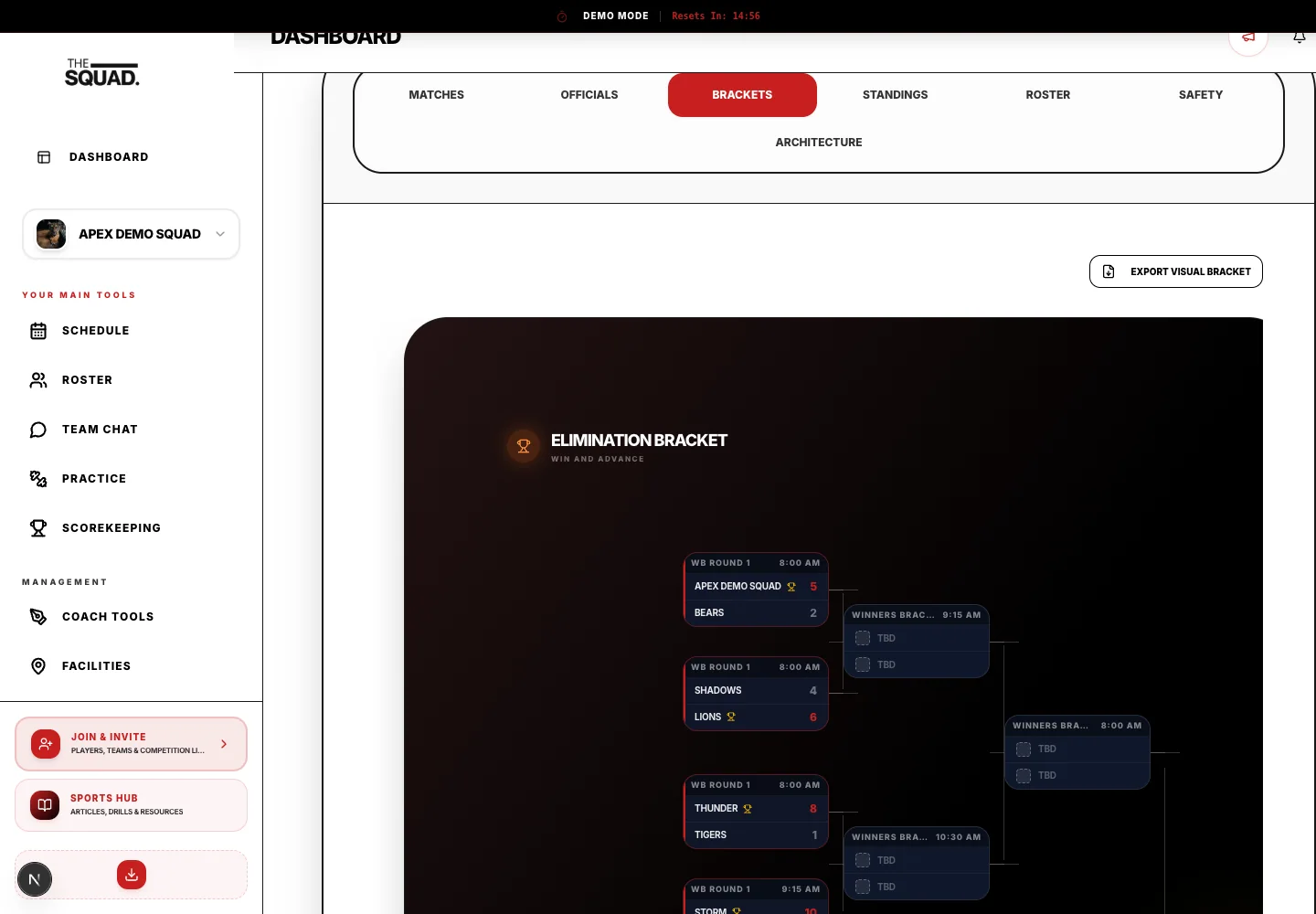
A tournament format is the set of rules that determines opponents, advancement, elimination and the number of games participants can expect.
How do you choose between knockout, round robin and Swiss formats?
Compare available time, guaranteed games, advancement rules and venue capacity before choosing a format.
Two tournament directors running 16 teams with the same field resources can create wildly different experiences depending on which bracket format they choose. One format might guarantee every team 3+ games; another sends half the teams home after one loss.
Format selection is a design decision that directly affects athlete experience, operational complexity, time requirements, and the competitive legitimacy of your final result.
Format 1: Single Elimination
The concept: One loss and you are out. The bracket advances until one undefeated champion remains.
The math for N teams:
- Number of games = N - 1
- Number of rounds = log base 2 of N (for power-of-2 brackets)
- For 16 teams: 15 games, 4 rounds
- For 32 teams: 31 games, 5 rounds
Pros:
- Maximum drama — every game matters completely
- Operationally simple to run
- Fastest format; minimum time per team
- Requires the fewest fields and time slots
- Familiar to participants — everyone understands it
Cons:
- Teams can be eliminated after one game (terrible participant experience)
- A single bad performance can eliminate a strong team
- Results are less accurate reflections of true team quality
- Upsets disproportionately affect results
Ideal use cases:
- Final rounds of a tournament after guaranteed pool play
- Large field events where time constraints are significant
- High-profile events where drama and sudden-death stakes are part of the appeal
Not ideal for:
- Developmental or youth tournaments where guaranteed games are a priority
- Small-field events (4–6 teams) where everyone could easily play everyone
Format 2: Double Elimination
The concept: Each team gets a "second life" — one loss moves them to the losers' bracket rather than eliminating them. Eliminated only upon a second loss.
The math:
- Number of games = (2N - 1) or (2N - 2) depending on if a bracket reset is used in the final
- For 16 teams: 30 games without a championship reset, or 31 with a reset
- Requires approximately twice the time and field resources of single elimination
Structure:
- Winners' Bracket — Undefeated teams advance
- Losers' Bracket — Teams with one loss; another loss eliminates
- Championship — Winners' bracket winner vs. losers' bracket winner
Bracket reset rule: If the losers' bracket winner beats the winners' bracket champion, both teams have one loss each. A reset means playing one more deciding game.
Pros:
- Every team is guaranteed at least 2 games
- More accurately identifies the best team over time
- Manages upsets better — a strong team can survive one bad performance
- High drama in the losers' bracket (every game is elimination)
Cons:
- Significantly more complex to administer
- Takes roughly twice as long as single elimination
- Bracket management requires careful attention
- Difficult to run with limited field/court resources
Ideal use cases:
- Competitive tournaments where competitive legitimacy matters more than speed
- Regional or national level events
- Events with adequate field resources and time (full day or multi-day events)
Not ideal for:
- Same-day small tournaments with 3–4 hours total
- Formats with more than 16–20 teams (becomes very long)
Format 3: Round Robin
The concept: Every team plays every other team. Final standings determined by record, then tiebreakers.
The math:
- Number of games = N x (N-1) / 2
- For 4 teams: 6 games per pool
- For 8 teams: 28 games — this is why full round robins only work for small fields or pools
Tiebreaker order (standard):
- Head-to-head record
- Point differential (capped to avoid running up the score)
- Points scored
- Coin flip (last resort)
Pros:
- Maximum guaranteed games for every team
- Most accurate reflection of true team quality
- No "bracket luck" — every game counts equally
- Great participant experience (especially at developmental levels)
Cons:
- Only practical for small groups (4–6 teams per pool)
- Late-game scenarios can become meaningless if standings are already decided
- Score-running controversies when point differential matters for tiebreakers
Ideal use cases:
- Pool play within a larger tournament (4-team pools are the sweet spot)
- Developmental leagues at the youth level
- Small invitational events (6–8 teams)
Not ideal for:
- Large fields (16+ teams) as a standalone format
- Events with tight time constraints
Format 4: Swiss System
The concept: Borrowed from chess tournaments. Teams are paired each round against opponents with a similar record. No teams are eliminated. After a preset number of rounds, final standings are determined by record and tiebreakers.
The math:
- Number of games per team = number of rounds (you choose)
- For 16 teams, 5 rounds: 40 total games, every team plays 5
How pairings work:
- Round 1: Random or seeded pairings
- Subsequent rounds: Team with 2-0 record plays another 2-0 team; 1-1 teams play 1-1 teams; etc.
- No repeat matchups
Pros:
- Every team plays every round — no elimination
- Games remain competitive because similar-record teams meet
- Scales well for large fields without exponential game count
- More accurate than single elimination for identifying top teams
Cons:
- Less familiar to most participants — requires explanation
- Tiebreakers at the end can be complex and disputed
- Does not produce a definitive champion through a playoff without additional bracket rounds
- Scheduling logistics each round depend on results of previous round
Ideal use cases:
- Large tournaments (16+ teams) where you want guaranteed games for everyone
- Events emphasizing development over elimination drama
- Fantasy leagues or skills competitions
The Pool-Play + Bracket Hybrid (Most Common Best Practice)
For most youth and amateur tournaments with 8–32 teams, this is the recommended format:
- Pool Play (Round Robin, 3–4 games guaranteed): Divide teams into balanced pools of 4. Each team plays 3 pool games. This guarantees participation value.
- Bracket Play (Single Elimination, highest drama): Top 1 or 2 teams from each pool advance to a bracket. This determines a legitimate champion.
Why it works:
- Every team gets multiple guaranteed games
- Bracket stakes create high drama
- Time and field requirements are manageable
- Competitive legitimacy improves because bracket seeding is based on pool performance
Quick Reference Decision Table
| Format | Teams | Time | Fields Needed | Guaranteed Games | Best For |
|---|---|---|---|---|---|
| Single Elimination | 8–64 | Short | Few | 1 | Finals brackets, large events |
| Double Elimination | 8–20 | Long | Many | 2 | Competitive validity, smaller fields |
| Round Robin | 4–8 | Medium | Few | N-1 | Small groups, developmental |
| Swiss | 8–32 | Medium | Moderate | = # rounds | Large events, no elimination desired |
| Pool + Bracket Hybrid | 8–32 | Medium-Long | Moderate | 3–5 | Most youth tournaments |
Running a Double Elimination Tournament: Complete Director's Guide
What Is Double Elimination?
In a double elimination tournament, a team must lose twice to be eliminated. After the first loss, a team drops to a "losers' bracket" and gets a second chance to advance. Only the champion of the winners' bracket and the winner of the losers' bracket play in the final — and if the losers' bracket champion wins, a second championship game is required (since the winners' bracket team hasn't lost yet).
Double elimination is popular because it feels fairer — one bad game doesn't end your tournament. The tradeoff is scheduling complexity and more total games required.
Game Count Formula
For N teams in a double elimination bracket:
- Minimum games: (2N - 1) if the winners' bracket champion wins the final
- Maximum games: (2N) if a second championship game is required
For 8 teams: 15–16 games. For 16 teams: 31–32 games. Plan your field/court allocation and time accordingly.
Bracket Structure
Winners' Bracket: Standard single elimination bracket. All teams start here.
Losers' Bracket: Teams that lose a game in the winners' bracket drop here. The losers' bracket has more rounds and a more complex structure because teams are fed in from different rounds of the winners' bracket.
Key structural rule: A team that loses in the losers' bracket is eliminated. No third chance.
Championship: The winners' bracket champion vs. the losers' bracket champion. If the losers' bracket champion wins, play a second game.
Scheduling Double Elimination
Double elimination is scheduling-intensive because losers' bracket games often depend on winners' bracket results completed in the same time block.
Scheduling approach:
- Build the winners' bracket schedule first (standard scheduling)
- Map which losers' bracket games depend on which winners' bracket results
- Assign losers' bracket games conservatively — build in buffer time after the dependent winners' bracket game
- Use the formula: losers' bracket game can begin 30–45 minutes after its feeding game ends
Most common mistake: Scheduling a losers' bracket game to start before the winners' bracket game that feeds it can realistically finish.
Court/Field Allocation
Double elimination requires more simultaneous courts/fields than single elimination to complete in the same time window. Rule of thumb: to run an 8-team double elimination in one day, you need at least 2 courts/fields. For 16 teams, plan for 4+ courts/fields.
When Does the Tournament End?
Unlike single elimination, the end time for a double elimination tournament is less predictable because:
- If the losers' bracket champion wins the final, there's an extra game
- Losers' bracket games can pile up if early games run long
Build in 60–90 minutes of buffer past your scheduled final time for any double elimination tournament. Communicate this to participants.
Is Double Elimination Right for Your Tournament?
Choose double elimination when:
- You have enough fields/courts and time to support the extra games
- Your participants are traveling and want a guaranteed second game
- Your event is a high-stakes competition where one bad game feels unjust
Choose single elimination when:
- Time or field constraints are tight
- Tournament is more recreational in nature
- You want the cleanest bracket narrative (single elimination produces more dramatic brackets)
Choose pool play + bracket when:
- You want guaranteed games for all teams (pool play) with bracket drama (playoff round)
- This is the most common format for large amateur tournaments
Pool Play Management: Structure, Tiebreakers, and Advancement
Why Pool Play Works
Pool play + playoff bracket is the most common format for large amateur and youth tournaments. It solves the core problem of single elimination: every team gets multiple games, regardless of first-game performance. Teams that travel hours get genuine value even if they struggle in the bracket.
The format works like this: teams are divided into pools (typically 3–5 teams) and play a round-robin within their pool. Top finishers from each pool advance to a playoff bracket.
Designing Your Pool Structure
Pool size considerations:
- 3-team pools: 3 games per team per pool round. Fast. Good for tight schedules.
- 4-team pools: 3 games per team. Most common. Excellent balance of games and schedule.
- 5-team pools: 4 games per team. Maximum guaranteed games, but requires more time.
Seeding teams into pools:
Use a "snake draft" approach: if you have 4 pools, seeds 1–4 go to pools 1–4, seeds 5–8 go to pools 4–1 (reverse), seeds 9–12 go to pools 1–4, etc. This distributes strength evenly across pools.
Avoid: Placing teams from the same region or club in the same pool when possible — they've often played each other recently.
Advancement Rules
Communicate advancement rules before the tournament starts. Common formats:
- Top 1 from each pool: Simple, creates clear bracket seeding by pool finish
- Top 2 from each pool: Doubles advancement, larger bracket
- Top 2 + wild cards: Top 2 from each pool advance automatically; wild card spots go to the next-best finishers across all pools by tiebreaker
For wild card advancement, use a single consistent metric — typically points differential capped at a maximum per game (e.g., no more than +7 per game) to prevent teams from running up the score.
Tiebreaker Rules (Publish Before the Tournament)
Tiebreakers within a pool should be defined in advance and applied in order. The most common sequence:
- Head-to-head record between tied teams
- Points differential in head-to-head games (capped)
- Total points differential across all pool games (capped per game)
- Total goals/points allowed (fewest wins)
- Coin flip or random draw (last resort)
Why cap points differential? Uncapped differential incentivizes running up scores, which destroys sportsmanship and creates unpleasant experiences for opponents.
Real-Time Pool Standings
Post real-time pool standings so teams can track their advancement position. This is especially important in the final pool round when advancement scenarios are live.
Have a designated person responsible for updating standings after each game. Participants who can track their own standing in real time are more engaged and ask fewer questions at the information desk.
Common Pool Play Mistakes
1. Not publishing tiebreaker rules before the event
Surprise tiebreaker decisions breed resentment. Publish them in pre-tournament materials.
2. Not capping points differential
Creates incentive to run up scores. Kills sportsmanship.
3. Poorly designed pools
All-strong pool vs. all-weak pool makes advancement feel unfair. Invest in seeding.
4. Unclear advancement scenarios
Teams in the final pool round should know exactly what results they need. Post this visibly.
Round Robin Scheduling: Formulas for Any Number of Teams
The Round Robin Basics
In a round robin tournament, every team plays every other team exactly once. It's the fairest format because all teams face the same competition set, and it maximizes guaranteed games for all participants.
The challenge: scheduling round robins efficiently — especially with odd numbers of teams, multiple courts, and time constraints.
Game Count Formula
For N teams in a round robin:
- Total games: N × (N-1) / 2
- Rounds: N-1 (if N is even) or N (if N is odd — one team gets a bye each round)
Examples:
- 4 teams: 6 total games, 3 rounds
- 6 teams: 15 total games, 5 rounds
- 8 teams: 28 total games, 7 rounds
Building a Round Robin Schedule (Even Number of Teams)
Use the "rotation method":
For N teams (even), assign teams numbers 1 through N. Fix team 1 in place. In each round, rotate the remaining teams:
Round 1: (1 vs N), (2 vs N-1), (3 vs N-2)...
Round 2: Rotate all except team 1 one position clockwise
Repeat until all N-1 rounds are complete
This guarantees each pair plays exactly once and each team plays in every round.
Odd Number of Teams
When N is odd, add a "bye" as a virtual team (team 0). Any team scheduled to play team 0 has a bye that round. Use the same rotation method with N+1 "teams."
Multi-Court Scheduling
With multiple courts, games within a round can run simultaneously.
Courts needed per round: If you have R games in a round and each game takes T minutes, and you want the round done in X minutes:
- Courts needed = R / (X / T) = R × T / X
Example: 4-team round robin, 3 games per round, 45-minute games, want each round done in 45 minutes = 3 courts needed.
Court assignment tip: Ensure the same pair doesn't play on the same court every time. Rotate court assignments with team assignments.
Rest Between Games
Build in minimum rest periods. For youth athletes, 30–45 minutes between games is appropriate. For adult recreational players, 20–30 minutes minimum.
In a tight schedule, this limits how many games can occur simultaneously and how many rounds can be completed per day.
Publishing the Schedule
Every team needs their schedule clearly:
- Team name / color / identifier
- All game times
- Court / field assignment
- Opponent for each game
Provide this in the pre-tournament communication, at check-in, and via the live tournament link. Color-code by team for readability on posted schedules.
Helpful Scheduling Tools
- Challonge: Good for smaller round robins, free tier available
- Tourney Machine: Excellent for youth sports, handles pools + brackets
- Excel templates: Various free templates available online for specific team counts
- BracketHQ: Online tool with round robin generators
For anything over 20 teams, use dedicated software — manual scheduling becomes error-prone.
Seeding in Tournaments: How to Set Up Competitive Balance
Why Seeding Matters
A tournament with poor seeding predictably delivers the same two top teams in the final while every other division game is a mismatch. Teams that traveled hours for a single lopsided game don't come back next year. Seeding — done well — creates the competitive balance that makes brackets compelling from the first round to the last.
Methods for Seeding Teams
Method 1: Committee Seeding (Subjective)
A small committee of knowledgeable individuals (coaches, league administrators, neutral parties) reviews team information and assigns seeds based on expert judgment.
Best for: Leagues where committee members have direct knowledge of teams
Advantages: Can account for contextual factors (injuries, strength of schedule, recent performance trend)
Risks: Perceived bias, especially if committee members have conflicts of interest
To minimize bias: require committee members to recuse from seeding any division where they have a direct connection, document rationale for each seed, and publish an appeals process.
Method 2: Record-Based Seeding
Seed teams by win-loss record, with tiebreakers applied in order.
Standard tiebreaker sequence:
- Head-to-head record
- Points differential (capped per game to prevent blowout gaming)
- Points allowed
- Strength of schedule (average record of opponents)
- Coin flip or random draw
Best for: Leagues with standardized competition (all teams played same opponents or same number of games)
Limitation: Unfair when teams played in leagues of dramatically different competitive quality
Method 3: Rating System Seeding
Use a mathematical rating system (Elo, RPI, or custom point-based system) that accounts for win/loss, margin of victory, and opponent quality.
Best for: Large tournaments drawing from multiple leagues or regions
Advantages: More objective, accounts for schedule difficulty
Disadvantages: Requires clean historical data, complex to explain
Method 4: Open Draw (Random)
For recreational or social tournaments where competitive balance is less critical, a random draw with top seeds protecting against first-round rematches is acceptable.
Protecting Top Seeds in the Bracket
Standard seeding protects top seeds from playing each other until later rounds:
- Seed 1 and Seed 2 are placed in opposite halves of the bracket
- Seeds 3 and 4 are placed in opposite halves from each other
- Seeds 5–8 are distributed to avoid concentration
Communicating the Seeding Process
Transparency reduces complaints. Before the tournament:
- Publish the seeding methodology in advance
- Release seeds with brief rationale (if committee-based)
- Provide a clear process for seeding concerns (before the bracket is finalized)
- Set a deadline for concerns — no changes after bracket publication
When Teams Dispute Their Seed
Disputes are inevitable. Handle them with a defined process:
- Team submits concern in writing within 24 hours of seed release
- Tournament director reviews with the original seeding source
- Decision communicated with rationale within 48 hours
- No changes after the appeal deadline
A fair process, clearly communicated, resolves most disputes — even when the team isn't happy with the outcome.
Sources and further reading
- Tennis NSW: Match and Draw Formats — A governing-body example of round robin, knockout and group-to-playoff formats. Tennis rules are examples, not rules for every sport.
- FIDE Handbook: General Handling Rules for Swiss Tournaments — The federation’s rules document Swiss-system pairing administration. Apply your own governing body’s competition rules.